Developing an individual approach to image-making or a personal style is an ongoing process, Paul Nicklen writes.
It's a lifelong endeavor. No one picks up a camera and is the finished article. In fact, I don't think it's possible to reach a definitive place with your photography; the way one makes pictures is always evolving. But that is something to embrace.
By embarking on a life in photography, you are making a commitment to yourself to keep doing the work – developing your eye [see Chapter 8 of Paul Nicklen: A Photography Masterclass] and knowledge [Chapters 7, 10 & 11], nurturing your self-belief [Chapter 5], regularly checking in with your reasons for doing what you’re doing and remaining focused on your goals [Chapter 3].

Nicklen is a Canadian photographer, filmmaker and marine biologist who uses his camera to reveal the nature of the changing polar regions due to the effects of a warming planet.
He has documented the beauty and plight of our planet for over 20 years as an assignment photographer for National Geographic magazine.
Paul is the co-founder (along with his wife, Cristina Mittermeier) of SeaLegacy, an organization that highlights ocean conservation issues to the global community.
His new book, Paul Nicklen: A Photography Masterclass is based on Paul's online Masters of Photography course. This is a sample chapter from that book.
One of the most useful things I learned at the beginning of my career was how National Geographic magazine edits photography [Chapter 16]. It's a model I use to this day.
Let's say I had shot 10,000 images on an assignment. An editor would narrow down the images to around 1,000 'top' images.
We'd then look at the images together and whittle them down to 500, 200, 100, a top 50, and then 25 to 35 standout images.

Find your style
Those images would make it into the final story 'tray'. (We called it a 'tray' because we used to use Kodak carousel slide projectors that were fed by a rotating tray of slides.)
I mention this because having insight into the editing process and style will help you learn about your style, your way of shooting, and identify those of your images that will hopefully live on forever.
Aside from the 'home run' images, to use a baseball analogy, it's also a chance to identify 'second base' and 'third base' hits – the solid B and C-level images that serve as a supporting cast.
These are the images that capture key journalistic storytelling moments, images that are perhaps not as powerful as those 'big hitters', but that help to tell the story. They're like legs on a table that give the whole story structure.

Clear story
It's important you don't get disheartened if somebody doesn't 'get' your style straightaway. For my first few assignments at National Geographic, none of the editors understood my style.
I am in love with wildlife and nature. I want my images to be either extremely full frame – where you’re looking at the eye or into the mouth of an animal that is taking up the whole frame – or to convey a sense of place – where the animal is just a speck in the distance against a big, beautiful landscape.
Those kinds of images really speak to me, but they are not necessarily what the editors at National Geographic are looking for. What will work as a large fine-art print on the wall may not work in the pages of a magazine.
A strong journalistic image tells a clear story with context and consequence – it's about truth revealed, not just beauty captured. Fine art, by contrast, invites interpretation and emotion, often leaving the narrative open.
So, don't get discouraged if your style doesn't immediately fit with what an editor wants.

Paul Nicklen's '20-60-20 philosophy'
My style is me, it's who I am, it's how I shoot. You have to hold on to that, to believe in what you are doing and chase those little voices out of your head [see Chapter 5].
A technique I often use to push myself creatively and grow as an artist is something I call my '20-60-20 philosophy'.
It is a way to get the shots I need, but also to experiment, to be bold or daring in the way I'm shooting – to break the rules – which I hope will, in turn, lead to images that are a bit different.
When I'm in the field, I'm in the moment, I'm in the zone. I want to spend the first 20 per cent of my time getting sharp images, in focus, properly exposed – something that the editors at National Geographic, or whoever I'm shooting for, want.
Even if it's just for myself, I want to get a core body of workable images. Essentially, you're not putting too much pressure on yourself to make every image a home run. So that's the first 20 per cent of your time – just getting something usable on your cards.
After that first 20 per cent, which I move through quickly, I spend the majority of my time in the 60 per cent zone, where I'm in the moment, using my skillset as an artist, using whatever techniques I've learned.
I might be using rear sync flash to shoot motion blur, which demands precise timing and control over ambient light and the subject's movement – too much light and the blur overwhelms the subject; too little and you lose the motion altogether.
Or I could be taking complex shots where the chance of success is still there, although somewhat reduced.

Bear this in mind
Crucially, I'm pushing myself to the outside edges of my ability, using all my developed skills, all my experience with a camera.
One mistake I see a lot of photographers making is putting on the same lens and photographing the same bear over and over in the same way. It might be a 600mm lens and a bear that's 45 yards (50 meters) away.
At the end of the day, they will have shot the same picture many times; same angle, same focal length, same depth of field or same framing of the subject.
Once I have exhausted that 60 per cent and I'm feeling great about the shoot, thinking I've captured some really creative, artistic stuff – incidentally, that 60 per cent zone is where the majority of my best work comes from – after that, I'll spend the remaining 20 per cent of my time in the last zone where I just try some 'Hail Marys'.
'Hail Marys'
I might be tired, the sun's getting low, and things aren't really working anymore, but nonetheless, I'll keep going for a while longer on the off-chance that something will happen.
I've been underwater in eight knots of current off the British Columbia coast, where all I could do was try something and hope for the best, as there was little chance of getting anything in focus.
I didn't have a tripod to steady the camera, of course, and it was pitch-black, but I could see my dive buddy lighting up the scene with his powerful dive flashlight.
What did I do? I took a 20-second handheld exposure. That's a 'Hail Mary', where the chances of success are slim to none.
In fact, what came from that moment was incredible, something I could never have predicted: I could see light coming off the flashlight and bending over rocks, traveling with the current.
This gave me the idea to use organic dye to track and trace the currents in the ocean. It resulted in an image that ran in National Geographic.
I wouldn't have got the idea of using the dye unless I had seen the light bending across the rocks. The best part about spending time in the last 20 per cent zone is that you grow as an artist.
You are developing skills that are going to help you later in your photographic journey.
And maybe, in time, the techniques that you're testing in the last 20 per cent zone move into the 60 per cent zone, they become part of your regular skillset, and you find you are shooting successful images that push the limits of creativity.
That is how you grow as an artist. And that is what this is all about.
Buy Paul Nicklen: A Photography Masterclass

Paul Nicklen: A Photography Masterclass is published by Frances Lincoln, with Masters of Photography (ISBN: 978-1-83600-981-8) and is priced $25/£18.99.
Read more

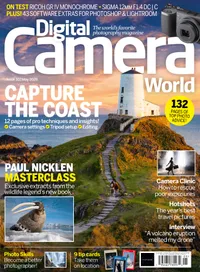
A longer version of this extract appears in the May issue (307) of Digital Camera World magazine.
You can subscribe and get the magazine delivered to your door every month. Choose between a print or digital subscription, or a bundle of the two.
All print subscribers to Digital Camera magazine can now access digital back issues dating from 2009 (when using iOS) or 2012 (when using the Pocketmags Magazine Newsstand app or the Pocketmags website).