The best camera deals, reviews, product advice, and unmissable photography news, direct to your inbox!
You are now subscribed
Your newsletter sign-up was successful
An account already exists for this email address, please log in.
No polar bears, no wind farms: this outdoor exhibition asked 20 photographers to find new ways of showing the climate crisis, and they didn't hold back
Plants swallow a Chernobyl cooling tower, tourists gawp at a melting glacier and Sri Lankans recycle discarded plastic into wearable art
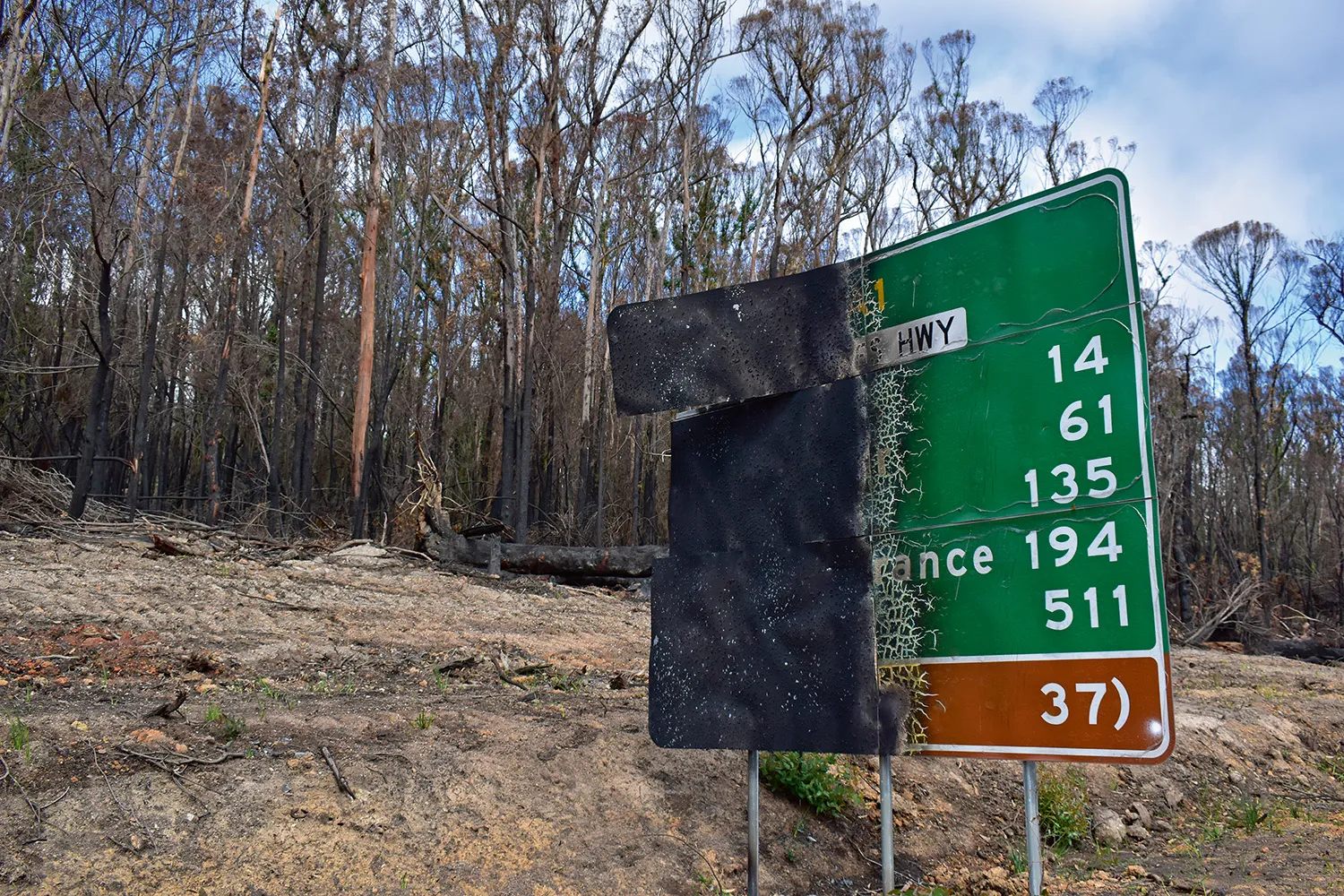
Kilometres to where? (2020). "A powerful image that shows the extent of damage that was caused by the Black Summer bushfires in Australia. I was travelling by campervan along the A1 Princes Highway through New South Wales and Victoria when I passed this road sign which had been half destroyed by a bushfire that had travelled across the immediate roadside landscape and appeared to halt at the road. Over 24 million hectares of land and 3 billion terrestrial animals were killed or displaced, respectively."(Image credit: Ann Petruckevitch)
When you think of images representing climate change, a number of clichés come to mind. A wind or solar farm; a lone polar bear on an ice floe. You know the kind of thing.
But while these are all real things that really exist, let's be honest. They've become so familiar to us, they've lost whatever impact they once had.
OPEN ECO is going in a different direction. Held outdoors at the Seafront Gallery in the English seaside resort of Brighton, the exhibition brings together 20 artists, selected through an international open call.
Each is showing a single photograph in response to a single question: how can photography make a difference to the climate crisis? There's no single answer, and that makes sense because the climate affects, well, everything.
A range of responses
So for example, Mark Phillips's The Rhone Glacier retreats exposes protection efforts at a Swiss glacier that are driven by tourism. Meanwhile for The Catch of the Day, Dr Gil Mualem-Doron worked with young Sri Lankans to turn plastic washed up on the beach into wearable sculptures.
Overshoot (2026). "In 2015, a limit was set for global warming: 1.5 degrees Celsius. Overshoot refers to exceeding this limit. Isn't the behaviour of tourists who take souvenir photos in front of broken-off ice floes, rather than engaging with the melting of a glacier, also a form of overshoot? It begs the question if these photos will make a difference to the climate crisis." (Image credit: Britta Kohl-Boas)
The Catch of the Day (2026). "The photograph is part of Sea of Change, a collaborative photography series created with young people from a fishing village in northern Sri Lanka. Participants transformed plastic waste collected from local beaches into wearable sculptures, masks and costumes, which were then photographed within the coastal landscape. The project connects local experiences of pollution and coastal precarity to the global ecological crisis, while showing how discarded materials can take on new meanings through creativity and collective action. Supported by the Chalk Cliff Trust and We Are Kommune, Kalpitiya, the project was exhibited at the Lionel Wendt Art Centre in Colombo." (Image credit: Dr Gil Mualem-Doron)
As time goes bye (2025). "Does nature have the capacity to repair the damage we inflict upon it? Can it heal itself and erase the traces we leave behind? Cars are symbols of human technological progress, of status, and of our freedom of movement. Yet they also symbolize our thoughtless emissions and our reluctance to change for the sake of nature. This photograph was taken at an abandoned auto repair shop near Kyrkö Mosse in southern Sweden, where vegetation is slowly taking over and obliterating the traces of human activity." (Image credit: Kerstin Rudnick)
Some photographers document nature reclaiming the spaces humans have left behind. In Monument, for instance, Halfdan Hallseth captures plants and trees reclaiming the cooling tower of Chernobyl's Reactor 5, while Kerstin Rudnick's As times go bye shows vegetation overrunning abandoned cars in Sweden.
Others focus on damage already done. Ann Petruckevitch's Kilometres to where? shows bushfire destruction along an Australian highway, and Rebecca Goddard's Fly records the impact of fly-tipped waste in England.
Get the Digital Camera World Newsletter
The best camera deals, reviews, product advice, and unmissable photography news, direct to your inbox!
Across all 20 images, there's a tremendous variety of techniques and subjects, and limiting contributions to one picture per photographer has really paid off.
Fly tip (2025). "In Avonmouth, near Bristol, a huge area of fly-tipped rubbish grew over a number of weeks like a sleeping toxic giant with asbestos in its veins. The site, home to waste processing and incinerators, sewage works and warehouses, but also to pockets of nature reserves, quiet spaces and wildlife, was closed off to those wishing to walk and explore this place after the site was cleared. This area was once salt-marsh, regularly flooded by the tidal River Avon." (Image credit: Rebecca Goddard)
Monument, from the series Chernobyl (2020). "On the floor of the unfinished cooling tower of Chernobyl's Reactor 5, a tree grows through layers of concrete and decay. Built beside Reactor 4, the site bears the scars of one of history's most devastating technological disasters. The tree becomes a Monument to Life - not one built by humans, but by nature itself. Its roots and branches quietly reclaim a place designed to control immense forces. In the face of the climate crisis, the image offers both a warning and a possibility: nature is remarkably resilient, but its survival should not be mistaken for permission to keep pushing its limits." (Image credit: Halfdan Hallseth)
The Rhone Glacier retreats, from the series Asymmetries (2022). "An attempt to protect part of the Rhone Glacier with tarpaulin and insulation. The irony is that this protection exists because of the ice caves which are a tourist attraction. The main glacier melts, and retreats, still unprotected." (Image credit: Mark Phillips)
"The single-image format asks us to consider what a photograph can do within a wider conversation," says Photo Fringe producer Ricardo Reverón Blanco. "An image can act as evidence, testimony, warning or invitation. It can make visible what is overlooked, connect a local experience to a global condition, or encourage us to look again at the environments we inhabit every day."
Photo Fringe, a registered charity that supports early-career photographers and lens-based artists, runs until 31 October across Brighton & Hove, Newhaven and Portsmouth, with dozens of exhibitions in galleries, cafés, empty shops and other unexpected spaces. OPEN ECO is at the Seafront Gallery, 54 Kings Road, Brighton BN1 2HJ, from 5 October to 1 November, as part of Photo Fringe 2026.
Tom May is a freelance writer and editor specializing in art, photography, design and travel. He has been editor of Professional Photography magazine, associate editor at Creative Bloq, and deputy editor at net magazine. He has also worked for a wide range of mainstream titles including The Sun, Radio Times, NME, T3, Heat, Company and Bella.
You must confirm your public display name before commenting
Please logout and then login again, you will then be prompted to enter your display name.