
Buying your first "proper" camera is an absolute minefield. Which brand should you buy? Which lens should you get? What kind of memory card do you need? And then comes the cost, as you quickly discover that cameras aren't as cheap as you thought they were.
I used to teach photography, so I've been recommending "first cameras" for years. And if you're looking for the best beginner camera for you or someone else, I think the Canon EOS R100 is the best place to start – especially bundled with its kit lens, the Canon RF-S 18-45mm f/4.5-6.3 IS STM.
I'm going explain what all that means, why it matters and why it's the camera you should start your photographic journey with.
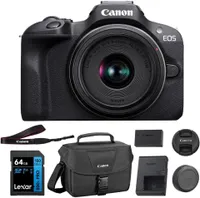
(If you're interested in this camera, there's currently an amazing Amazon Prime Day deal in the US where you get the camera, lens, memory card and bag for just $499.)
Is the Canon EOS R100 a good starter camera?
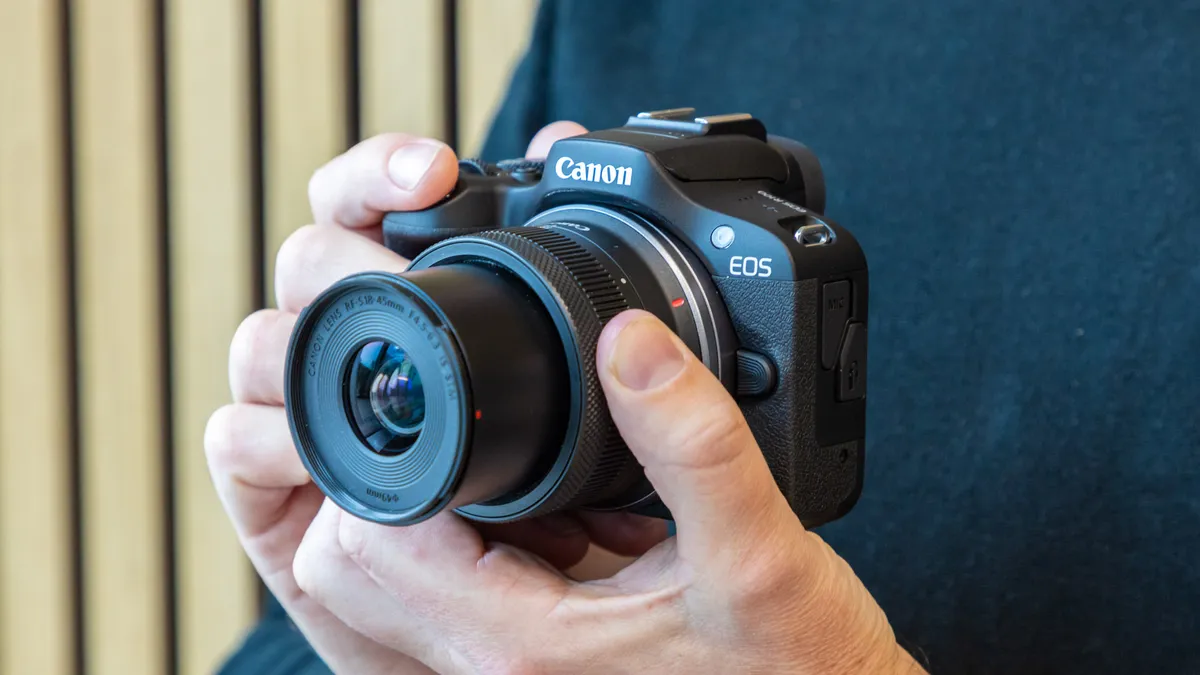
The first thing that makes the R100 perfect for newcomers to photography is the price: this is the only camera on the market with a truly entry-level price tag.
I know that $499 might not seem "entry level", but in the context of cameras – which typically cost thousands and thousands just for the body – trust me, $499 for a camera and lens is an absolute steal.
It achieves this price point by omitting everything but the essentials for learning photography. So there's no touch control, the rear screen doesn't tilt or articulate, and the 4K video has some compromises.
But as a pure photographic device, for learning how to use a camera and take great pictures, it's brilliant.
It has a high-resolution, 2.36 million-dot electronic viewfinder, which is the best way to learn how to "see" and compose your shots. It also reflects your camera settings in real time, so you can see what happens as you adjust the dials, making it a fantastic way to learn things like the exposure triangle.

It has a powerful 24.1MP APS-C image sensor, much bigger than the one in your phone, able to render crisp detail and beautifully shallow depth of field (aka blurry backgrounds). It also offers a burst rate of 6fps (frames per second), enabling you to fire off continuous frames when shooting moving subjects.
The menus are guided, too, helping you understand how these features work and how to achieve creative effects.
And the camera is also extremely compact and lightweight, making it easy to carry with you everywhere – whether you hang it off your neck or shoulder with the camera strap, or throw it in a bag or your glove compartment.
However, the biggest appeal of the R100 is that it gets you into the world of interchangeable lenses. You know that feeling when you use your phone to take a picture and you can't get close enough, or you can't get enough of the scene into your frame? Being able to change camera lenses liberates you from this problem.
Is the Canon RF-S 18-45mm a good starter lens?

The Canon EOS R100 often comes in a kit, or a bundle, with the Canon RF-S 18-45mm f/4.5-6.3 IS STM lens – which is why it is described as a "kit lens". What do all those letters and numbers mean?
'RF-S' is the lens mount employed by the R100. It means that the camera can mount any of Canon's RF lenses, but the 'S' denotes that the R100 has an APS-C image sensor (you can find out more in our What is sensor size? article). Because APS-C sensors are smaller than full-frame sensors, you have to apply a crop factor of 1.6x to the focal length of a given lens.
So in this case you multiply 18-45mm by 1.6x, which gives you an "equivalent" zoom range of 28.8-72mm. That's an incredibly versatile range that's perfect for everyday shooting, street and travel photography, and even some light landscape (at the "wider" 28.8mm end) and portrait (at the "longer" 72mm end) shots.
The 'f/4.5-6.3' refers to the lens' aperture range (how "wide" the aperture blades open, which dictates how much light reaches your sensor and how shallow your depth of field is). This isn't the "fastest" lens in the world (the lower the f-number, the "faster" a lens is) but it's perfect for starting your journey, with excellent center sharpness throughout the range.
Finally, the 'IS' stands for 'image stabilization' (meaning this lens offers shake compensation for handheld shots) while 'STM' refers to Canon's precision 'stepper motor' that delivers smooth, near-silent autofocus.
Does the Canon EOS R100 have good image quality?


Some people will tell you that beginner cameras are only good for beginners, but these shots illustrate the kind of image quality that the R100 is capable of. Yes, there are "better" cameras and more powerful image sensors out there – but I've taken shots on this sensor for portfolio and even paid client work, and never had any issues or complaints.
The Canon EOS R100 gives a newcomer everything they need to start mastering photography, but in professional hands it can deliver sensational shots.
The next model up, the Canon EOS R50, offers some very welcome improvements (not least an articulating touchscreen and full-fat 4K) but they come at a higher price tag – and I don't think a burgeoning photographer needs them.
So if you're considering which camera to get, for this price I simply don't think there's a better beginner camera and lens combo than the Canon EOS R100.
Get a great deal
You might also like…
Take a look at the best lenses for the Canon EOS R100 to see what your next lens should be. Personally, I think everybody should own a nifty fifty – so check out my Canon RF 50mm f/1.8 STM review.

