
The rise of hybrid shooting and advancements in LED technology have made continuous lighting the go-to for a wide range of content creators, and for good reason. It’s suitable for both photo and video purposes, some lights can produce millions of colors (no gels required), compatibility isn’t an issue, and the what-you-see-is-what-you-get workflow is highly accessible and attractive. But when it comes to serious portrait photography, I’m very much of the opinion that flash still reigns supreme for two crucial reasons: power and portability.
These attributes are exactly what the Neewer Q120 120Ws 2.4G TTL is designed to deliver. The way I see it, continuous lighting has become so trendy because it’s the more practical solution for a wider range of scenarios. That simply cannot be argued. But where a strobe light really shines, it blows continuous lighting out of the water. Let’s start with the primary reason, power…
Power to perform inside and out
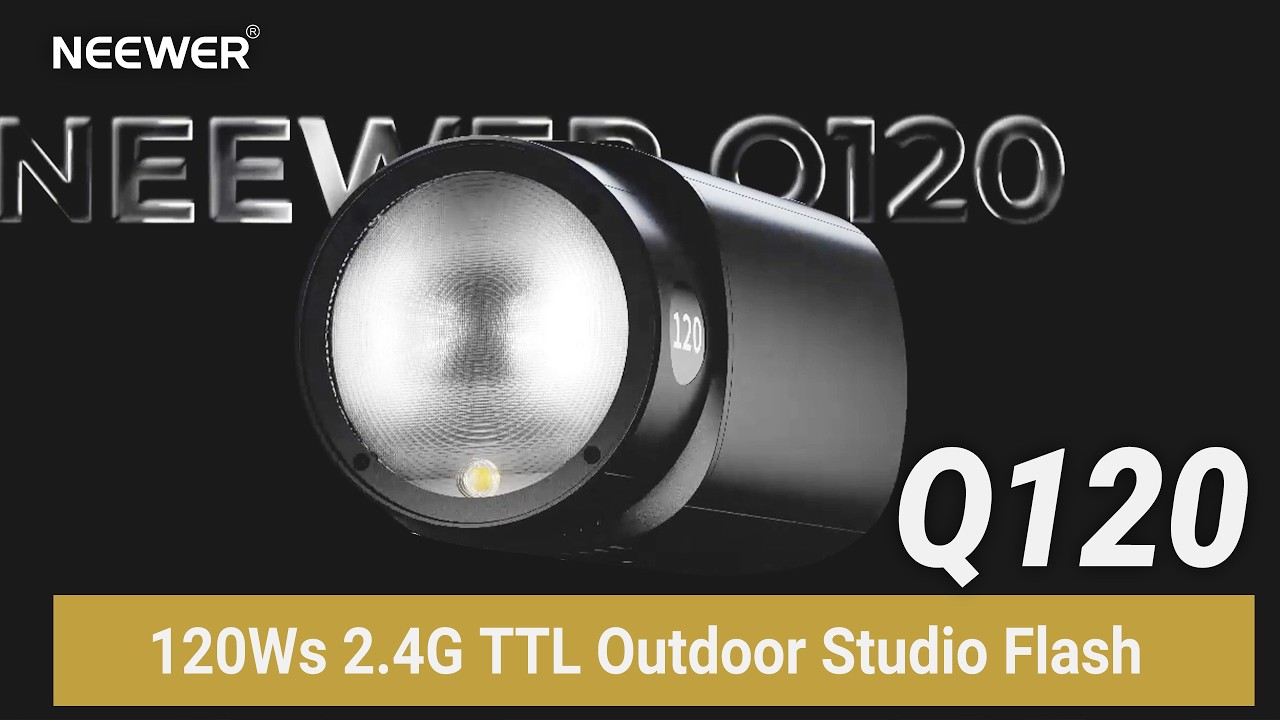
Continuous lighting simply cannot keep up with flash when it comes to output. This is because a continuous light has to distribute energy to provide a constant, steady beam of light without overheating. A strobe, like the Neewer Q120, essentially stacks the energy to produce a much higher output, without overheating, because the ‘pop’ of light lasts only a fraction of a second.
Move your shooting scenario into a daytime, outdoor setting and the advantages of flash become extremely clear. Plenty of continuous lights claim to boast outdoor attributes, but lighting conditions are highly variable. You might get away with using a highly portable continuous light on an overcast day or at sunset, but a strobe is going to offer much more grunt in high-contrast situations.

Now, don’t get me wrong, you still have to be realistic with your expectations. As the name suggests, the Neewer Q120 is only a 120-Ws strobe. It’s designed to provide power in a portable package. It provides nine stops of flash power adjustment from 1/256 to 1/1, has a flash duration of between 1/220 sec to 1/23,020 sec, for pin-sharp motion, and a recycle time of 0.01 to 1.5 seconds. It also has a built-in 28–105mm adjustable zoom system, which allows you to fine-tune the beam spread across multiple focal lengths, giving you greater control over lighting coverage and creative expression.
How well a light like this performs outside depends on a huge number of variables, such as its distance to the subject, how high-contrast ambient lighting conditions are, and what modifiers are being used. But this light isn’t billed as a solution to every outdoor eventuality like Neewer’s more powerful offerings. But it is a comparatively powerful solution when you consider its price and portability.

The Newer Q120 retails for just $199.99 / £208.99 / AU$299.99 / CAD$299.99 / €239.99 / JPY¥32999, making it an excellent step up for beginners with a flashgun, weighs only 1.5lb / 671g (with battery) and measures 3.2 x 3.2 x 5.6" / 81 x 81 x 143mm, which is roughly the size of a full-frame 24-70mm zoom. And while it comes in a padded bag, you could easily slip it into a lens slot in your camera bag for use in a pinch.
And this is where a portable strobe light really wins the outdoor portrait photography battle for me. Continuous lights that deliver a more usable output are much larger and often require a mains connection. The beauty of a small strobe like this is that you can have it in your bag, ready to go, as and when you need it.


Another boon is the ability to shoot up to 1/8000 sec via high-speed sync. Assuming your camera is able to sync at such speeds, you can work with the strobe in bright ambient lighting and at wide apertures without having to rely on an ND filter.
Neewer has specifically marketed this light as a tool for weddings, events, and commercial sessions. And that makes a lot of sense. If you’re a photographer who’s constantly on the move and needs to react to developing situations, a portable strobe arguably hits the sweet spot. But these situations also demand a quick setup and simple operation.
Speed and simplicity

Wedding and events photographers need to get set up fast. As you’d expect, the Neewer Q120 is a wireless strobe, which means it needs to be used with a compatible trigger. Not only does it work with Neewer’s proprietary Q system triggers and lights, it’s also compatible with the Godox 2.4G X System.
The included 3000mAh lithium battery is removable and said to power the light for 410 to 420 full-power flashes. A neat touch is that the battery itself has a USB-C port, which means you can charge the battery without it ever leaving the light, or purchase replacement Neewer NB-Z1 PRO batteries, which you can then charge independently from one another, so you have backup options out in the field.

The light is also compatible with a variety of modifiers, so you can shape the light that it emits. You also have the choice of using the physical on-board controls, complete with a small information screen, or operating the device wirelessly via a dedicated app (useful when working with groups of lights).
It’s not just the hardware that’s designed for speed. The Neewer Q120 features TTL, which is ideal for the fast pace of a wedding or event, when you simply don’t have the time to adjust your camera and flash settings manually. And with ±3EV compensation, you can ride the exposure-compensation dial and retain some control in trickier situations.
And, of course, for those engaging in a slower-paced commercial or on-location portrait shoot, when you have the time to really shape your lighting, you can go fully manual. Finally, a 3-W modeling light with 10 brightness levels enables you to lock focus in dark conditions.

